

Spalding & District Wildfowlers Association

The Creation of Moulton Marsh
MOULTON MARSH NATURE RESERVES JOINT MANAGEMENT COMMITTEE
South Lincs Nature Reserves Limited &
Spalding & District Wildfowlers Association
(A COMPANY LTD BY GUARANTEE AND NOT FOR PROFIT)
REGISTERED IN ENGLAND No. 934656 REGISTERED CHARITY NoP59446
HISTORY OF MOULTON MARSH 1979-2000.
The idea of a nature reserve at Moulton Marsh was first proposed in 1978 by Tony Creasey, a member
of S.D.W.A. and a serving council member of S.L.N.R. The shooting rights on this marsh were held
by the wildfowlers, but there had always been
an 1 agreement that this area should be a refuge
for wildfowl and not be shot over.
The first site meeting took place on June 12th
1978 between Messrs. Creasey, Cole and
Fitheridge from S.&.D.W.A. and Smith, Orton
and possibly Gunton from S.L.N.R. Both
organisations agreed that negotiations proceed
with S.H.I.D.B. the owners of the land with a
view to a lease.
After many hectic months, and a notification
from the L.C.C. that they wished to requisition
25 acres of the marsh for a rubbish tip, a lease
was finally signed on November 6th 1979
backdated to April 6th 1979 for 21 years on approx. 90 acres of salt marsh ( but not including the sea bank) at £1 per annum.
This was signed by Tony Creasey and Ivor Cole from S.&.D.W.A. and the Common Seal of S.L.N.R. was affixed.
A Joint Committee was formed to manage this area as a nature reserve consisting of T.Creasey, I Cole, D Dolton, representing the wildfowlers and A Smith, G Orton and G Harrod representing S.L.N.R. The L-C.C. pressed on with their plans for a rubbish tip on the nature reserve. On November 13th 1979 a public meeting was held in Fosdyke Village Hall. Officers from L.C.C. explained their proposals, why they preferred the marsh site rather than a Transfer Station at Spalding where the rubbish would then be taken to the old brick pits at Peterborough. They estimated that it would be cheaper to operate a landfill site at Moulton Marsh. Arnold Smith produced detailed figures showing that in the long term a Transfer Station would be the best value for the rate payer. Despite objections from the capacity audience, local people as well as many other organisations including (N.C.C. R.S.P.B. L.T.N.C. & C.C.) the L.C.C. deemed themselves planning permission on 15 acres of the reserve on February 18th 1980.Over the next few months the fight against this continued. The Joint Committee's main concern was that gulls and vermin would affect the wildlife, litter blowing all over the reserve would cause a problem, river quality would be affected as the leachates from the tip would get into the R Welland thus polluting the Wash S.S.S.I. itself and damaging its ecology. The L.C.C. commissioned a report by Prof. Kenneth Mellanby on what effects the rubbish tip may have on the wildlife and ecology of the immediate surroundings and marshes of the Wash. He stated that any leachate would not be a dangerous cause of pollution, even if it escaped into ditches or into the R Welland, and if small amounts did escape and had to be pumped into the river (providing this was done on a falling tide) there would be little if no ecological damage. His conclusion was that if the site was operated to a high standard it should have little effect on the area. Not surprisingly, the L.C.C. accepted his report.It was then that the L.C.C. threatened a compulsory purchase order if a sub-lease could not be agreed. Under this threat, G Harrod and G Orton prepared a Heads of Agreement and after much debate, agreement was finally reached on July 30th 1980 between S.L.N.R. and T Creasey and I Cole of S.&.D.W.Å. to grant a sub -lease to the L.C.C. on 15 acres on the site required for a rubbish tip for a period of 10 years 8 months with an annual rent of £3,800 to be reviewed at the end of 2yrs, 5yrs, and 8yrs. Half the rent would go to the S.H.I.D.B. as owners of the site. Conditions in the lease included provision of a car park, £750 towards a bird hide and a scheme for the planting up of the site with trees and shrubs as areas were completed and to maintain them for 5yrs. On quitting the site, to leave it in a safe condition and to comply with the requirements of a qualified engineer. Also to indemnify and keep indemnified from and against all liability arising in respect of the occupation and use of the site by the council. Furthermore. the L.C.C. gave an undertaking not to extend the tip area any further into the reserve. To accommodate the rubbish tip on the site a new sea bank had to be constructed. On July 31st 1980 the day after the Heads of Agreement was signed the S.H.I.D.B. moved in with their machines, work on the site had begun.
Over the next few months work went on apace
with building the new sea bank and digging out
compartments for the tipping areas. Thousands of
tons of soil were removed and stockpiled making
a lunar type landscape
A chain linked fence was erected around the
perimeter of the site as well as a large storage
building and services laid on. The roadway from
Middle Marsh road to the site was reconstructed
to carry the extra traffic.
It is not certain exactly when tipping actually commenced but it was probably during 1981.
While this was going on, attention was then focused on how best to develop the rest of the marsh site as a nature reserve. Under the direction of Arnold Smith, visits were made to Mimsmere and Titchwell for ideas and advice. Norman Sills the R.S.P.B. warden at Titchwell visited the site. Meetings were held with Geoff Beall of A.W.A. who, as part of their coastal protection plan were raising the sea banks from the Nene to the Welland. He spelt out his spoil requirements and identified the areas not suitable for use, and it was clear that his plan would fit in with the Joint Committee's proposals of scrapes and lagoons.
In the meantime the Joint Committee launched Operation 1 in March 1981. A moat was dug in the saltmarsh linking it to a main creek in an attempt to hold water. Parts of the top of the bank were gravelled. This area became known as the 'old marsh' and was not needed for bank raising.
By late 1981 the A.W.A moved in to raise
the sea bank. In consultation with them, 'The
Avocet Project' was agreed whereby they
created scrapes with inlet pipes from the R
Welland to feed them, as well as 2 lagoons
connected to them with islands and
promontories. The 3rd lagoon would be non
tidal. Levels were taken by Des Miles a
S.L.N.R. council member who undertook to
oversee the work.
By April 1983, raising of the sea bank was almost complete, but there was still a lot of work to do on the 'Avocet Project'. By June the lagoons had been graded but no work done on creating the scrapes. However after pressure from the committee, by late summer the scrapes had been completed with inlet pipes to R Welland and into the' lagoons. The autumn high tides overtopped the raw silt banks causing serious erosion problems.
It was fortunate at this time that the Manpower Services Commission was looking to find major projects for a team of unemployed people to work on.Arnold Smith was instrumental in obtaining funding for a team to work under the auspices of S.L.N.R. In July 1983 a community task force (C.T.F.) was formed under a supervisor John Ryle a biology graduate, an assistant Roger Nix a S.L.N.R. member along with 4 helpers. Later, they were to be joined by Ayla Smith another biology graduate, with the number of helpers increased to 20 people at times. Each person was allowed to be in the team for one year only.Although based at S.L.N.R. Spalding where facilities had to be provided, the committee purchased a vehicle to transport the team to work on the reserve. A tremendous amount of work was done by them especially on the lagoons and scrapes. However, in July 1984. Des Miles reported that the work done by the A.W.A. on the scrapes were not to specification and that they would not receive enough water as the inlet pipes were set at the wrong level, and the scrapes were not low enough. The A.W.A. felt that they had spent enough time and money and refused to do any more work on the project.
The Joint Committee then decided they would have to pay for the work to be done themselves and this was organised through a private contractor. This work was completed in August 1985 at a cost of 2380. The C.T.F. team continued for another year, this time under Harold Turner. He and his workforce did sterling work in relaying pipes in the scrapes, stoning around the inlet and outlet pipes using materials retrieved from the rubbish tip to arrest the erosion which continued to be a problem on the very high tides. They undertook a phragmites planting programme, transplanting them from various areas into and around the lagoons. They also planted tree and scrub cover around the lagoons. They built and installed the observation hide overlooking the lagoons. It was becoming obvious that the lagoons were not receiving enough water so a pipe was connected from a main creek into lagoon 2. This work was done by the wildfowlers under the guidance of Tony Creasey. They also built 2 more hides to overlook the scrapes.
We were fortunate in having Harold Turner
for another year, his practical experience
enabled the framework for the reserve to be
completed. However many problems came
to light over the next few years especially
when the high tides overtopped the scrape
bank and the inlet pipes were washed out.
We were fortunate when the N.R.A. stoned
the River Welland bank as part of their
river maintenance, they agreed to raise the
bank while the stoning strengthened the
inlet pipes to the scrapes. However, many
more obstacles had to be overcome regarding water controls over the coming years.. Scrub planting continued around the lagoons and hides installed. This work was now done by S.L.N.R. & S&DWA members as the C.T.F. team was very disorganised and unreliable under new supervisor R Speight. He was later replaced.
Work continued in the tip area. To provide screening, the south bank of the roadway was planted with trees by the wildfowlers in April 1983, and the promised carpark established by the L.C.C.
The first tree planting on the tip took place in
February 1984 when 1000 trees of various
species were planted by S.L.N.R. members and
C.T.F.
Each tree was supplied with stake, cane, tree
guard, mulch mat and a supply of peat.
As areas for planting were released, 1000 trees
were planted each year on the rubbish tip. Over
the period this was done by SLNR & S&DWA
members, CTF and Riseholme College
students.
To give the trees a better chance in such hostile
conditions, the trees were grown on for 1 yr in
the tree nursery at Arnolds Meadow (ex Pearsons field) before being planted out on the tip. There were terrible problems of litter blow, on many occasions all of the trees were festooned with paper and plastic, litter even affected the scrapes and lagoons at times. Extra high fences had to erected which arrested the problem. Methane channels were dug across the tip in 1989, but in 1990 new regulations meant that 5 tall chimneys were installed in the remaining tip area to allow the methane to escape.
In 1991 a drainage ditch was dug around
the infill site by the L.C.C. but there was
no outlet for the water to get away. Apart
from the roadway to the quay no water was
ever seen in the trench, the rainfall was
quickly taken up by the developing trees
and vegetation.
The three drought years of 1989/90/91
resulted in many of the established alder
silver birch and scots pine dying. Methane
had very little effect on the trees, where it
did escape, the vegetation was killed, but
later recovered. The species which had
'tully' tubes fared much better in the drought, so future planting all had them fitted. This created another problem as Gulls from the tip would regurgitate bones, plastic, and other items into the tubes, causing a build up of debris, thus killing the tree. Wire guards had to be fitted on the tops of the tubes to prevent this.
By 1989 the CTF was disbanded so all the work now had to be done by the members. In particular Richard and Kay Heath's Wednesday Team and Tony Creasey, Doug Shaws, Terry Gladwell and Rod Woodthorpe from S&DWA. A Tiger Turner grass cutting machine was purchased at a cost of £3000 to cut the network of paths in the woodland and wetland areas. The east scrape was also cut to encourage wildfowl in winter. This work was undertaken by the wildfowlers, Rod Woodthorpe. T Gladwell and Tony Creasey.
The lease on the tip was due to finish in March 1991, but in an effort to extend the life of the tip, the L.C.C. excavated the remaining tip and part of the first infill area to a greater depth and raised the height so that the tip took on a domed appearance. The tip was finally filled in March 1992 and the site vacated by L.C.C. As per the lease. a qualified engineer inspected the site to see if it had been left in a safe condition. His report was critical of the engineering structure of the tip. At his suggestion, firebeaters and signs warning the public that it was an infill site were put up. He recommended the monitoring of the leachates and methane by the L.C.C. and that we be indemnified against liability in perpetuity.
By 1993, there were only a handful of volunteers willing to work on the reserve, so the final planting on the tip was done by Crowders Nurseries under contract to L.C.C. when 2200 trees were planted in April, but many were blown over in the first gale. These were re-staked by the Wednesday Team and 200 replanted in the correct area. In all, 15,000 trees were planted over the 10 years, not including the many hundreds donated by Terry Gladwell and those grown from seed by S.L.N.R. Only time will tell on how successful the tree planting project was and what if any the effect the methane will have. Tree growth has been slow, but the alder, silver birch and scots pine planted 10 years ago have now reached 12-15 feet. It is not possible to say which species of tree have done best because so much depended on so many factors e.g. soil quality, depth and planting conditions which were mostly poor,
quality of tree and above all whether or not it was a good growing
season. Oak, silver birch, grey poplar, alder and hawthorn have
been reasonably successful, but evergreen species struggled.
Because of poor conditions, the flora on the tip was slow to
colonise. The dominant species being sea couch grass.
However, annual rye grass and clover were sown by the L.C.C.
from 1990 onwards which helped to suppress the rank vegetation
made tree planting easier.
On the higher drier part of the tip where wildflower seed was
sown, teasel, evening primrose, wildcarrot and hawkbits all
thrived. By 1994, parts of the maturing woodland was attracting
nesting birds.
Blackbird, song thrush, dunnock. wren, meadowpipit, skylark,
goldfinch, yellowhammer, reedbunting, mallard, red-legged
partridge, and pheasant proved breeding. Small flocks of finches
and buntings including corn buntings wintered on the reserve.
Moles colonised one particular area of the tip indicating the presence of worms. The lawyers wig fungi occurred on the rides along with a few other unidentified species. Huge numbers of small snails covered the area where clover and rye grass was sown. Enough open areas remained where plantings had failed to continue to support ground nesting species of birds.
The wetland part of the reserve continued to mature with the banks more stable. Erosion was a problem on the banks of lagoon 1 & 2 but stoning helped to arrest this. The west scrape was attracting grazing wildfowl, but wader numbers remained disappointingly low. However, the reserve was becoming more diverse and attracting more passerines who nested in the scrub areas. Short-eared owl and stonechat wintered on the reserve while winter thrushes fed on the sea buckthorn berries. Magpies were recorded in greater numbers.
The plant community too was developing
especially around lagoon 3 with strawberry
clover, sea milkwort and brookweed all
scarce plants in the area. The community of
wildflowers on the flood protection bank
complimented the reserve by attracting many
species of insect, notably butterflies, but the
Essex skipper butterfly actually bred on the
reserve.
Two species of groundhopper were recorded
around lagoon 3 in 1994 while grasshoppers were numerous in the grassland areas. Hares, fox, stoat, weasel, voles and moles occurred in good numbers, but rabbits had to be controlled because of damage to the flood bank. Phragmites continued to establish themselves in lagoon 3, while rushes and sedge colonised the lagoons including sea club rush. Marine life in lagoons 1 & 2 consisted of lugworm, cockles, crabs, and various crustacea. Spiral tasselweed provided nursery cover for small gobi, sticklebacks and other fish.
January 1994.
Washouts occurred under the south roadway and the one leading to the N.R.A. quay following the very wet autumn and winter.Leachates were recorded in the drain by the N.R.A. water quality officers and concern was expressed.The L.C.C. would not face up to their responsibilities and tried to pass the buck. They wanted the N.R.A. to do the work and to send the bill to us to pay, then claim it back through our indemnity with them. This we would not accept and there was stalemate for 12 months.In January 1995, a meeting was arranged between ourselves, Waste Disposal Authority ,Waste Regulatory Authority of L.C.C. the N.R.A. and S.H.I.D.B. to try to sort out the problem.At that meeting it was resolved that 6 boreholes would be sunk into various parts of the tip to find out the water level.The drainage ditch needed to be restructured with an outlet for the water into the drain. The W.R.A would design this and then put it out for consultation. No-one at the meeting would accept responsibility to maintain this ditch. We refused on the grounds that it was not our responsibility and that it was outside our boundary fence. The S.H.I.D.B .were asked to put it to their Board for them to maintain it, which they refused.There are parts of the tip where depressions have occurred and which fill with water. The W.R.A wanted these areas filled in to avoid the water percolating through the cap and picking up leachates. If this was done, there would have been a lot 'of damage done to some of the mature trees and it would be very expensive to carry out. Who would pay, would have to be sorted out later.
The N.R.A. agreed to cost the repair of the
roadway and promised to keep it as low as
possible. The W.D.A. hoped that the N.R.A.
would stand the bill.
The W.D.A. did say at the meeting that they
would honour our indemnity with them.
A week after this meeting, after heavy rain, the
'washout' under the quay roadway was made very
much worse. The N.R.A. acted immediately and
repaired it and the one on the south roadway by
putting in a membrane, at their own expense.
There has been no further washouts since. Once
the adjoining area was planted up with trees, run- offs ceased.
A meeting with the W.D.A. and contractor agreed where the boreholes, would be. Levels were also taken by L.C.C. Work was expected to start on the boreholes early March 1995.
Water skiers on the Welland continued to be a problem causing disturbance to birds on the scrapes. The Port of Fosdyke authorities would do nothing about it.
Another Open Day was held on August
14th attracting 78 visitors. The Nature
Trail now took them through the
developing woodland, and around the
lagoons making an interesting walk.
Butterflies were the main feature of the
day, while the wildflowers on the bank
added a splash of colour. Only the early
visitors saw any birds. A photographic
display on the history of the reserve was
on show creating a lot of interest.
March 1995. Contractors sank 8 boreholes in the tip area.. In some cases, the drillings came up dry and not decomposed at all while others were very wet and smelly. These boreholes would be monitored by the LCC over the next few years to monitor water levels.
May 1995. There was damage to trees and
scrub and erosion around Lagoons 1 & 2
when 4 consecutive surge tides of over 8m
overfilled them. ( The flap had been opened
to top them up for the summer as only 7m
tides were expected.) Water also seeped
through the cradge banks, we were lucky
they did not breach. The lagoons were at
least 6ft deep. As the tides fell away we
were able to open the flap and get reverse
flow, the first time this had ever happened. Levels returned to normal after a few days, but the damage was done. The scrapes too were overfilled by the high tides but no damage done.
The leaves of alder, willow, hawthorn and even sea buckthorn immediately turned brown. In an effort to save them, the Wednesday team coppiced them down. None of the alder survived, the willow being the most tolerant species, even so 50% of those affected died. However, there was still enough remaining to retain a screen of trees.
The scrapes too were overfull, but the river and cradge banks held even though they were overtopped in places.
The woodland now attracted passerine
birds notably Whitethroat, Turtle Dove,
Yellowhammer, Skylark and Goldfinch, all
proved breeding. The trees and scrub were
now mature enough to put on a show of
autumn colours. Butterfly species too were
beginning to colonise the main ride with
Small Heath and Common Blue. While the
large crop of thistles attracted Peacocks
and Small Tortoiseshell, they also
provided a food supply for a flock of 60-
80 Goldfinches.
Monitoring of the boreholes by LCC ceased by November.! !!!
1996. A tide of 8.82m on February 19ff was the highest ever recorded on the reserve and the highest since 1978 for the Wash. Damage was slight. But water got around the end of the cradge bank at lagoon 3 filling it to an unprecedented level. Trees close to the edge were affected by the saltwater uptake. The reedbed was not affected.Cradge banks between the scrapes and lagoons came within 9in of being overtopped. More leakage occurred through the banks leaving large amounts of silt deposits.
The cradge bank at the end of lagoon 3 was raised and the pipe between Lagoons 1&2 lowered free of charge by Tony Coupland and The Wednesday team.
In March a scheme by Mr Tom Tunnard to cattle graze our saltmarsh and bank came to abrupt end when the BSE crisis arose.
May 30th. 1997 The arrival of the New Age Travellers on the car park resulted in a lot of hard work trying to get them off. Notice was served but a writ was not necessary as they had left by June 14th However, more arrived July 2nd blocking our access with their vehicles. They finally left on July 20hThe carpark was left in a very tidy condition despite their occupation for so long.
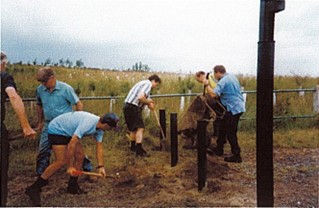
To prevent further occupation, a 2m
height restriction metal barrier
with 6 posts for either side was
bought for E480 made by Mr
Woolnough. The Wednesday team
dug the holes and helped erect the
structure, with it and the posts set in
concrete. Locks were then fitted.
A new sign stating No Overnight
Parking or Camping was then put up
to give us some legal protection if
the travellers returned again.
July 1997 the secretary escorted 80 members and guests of the SHIDB around part of the reserve on their Annual Inspection Day. It was their first ever visit to the reserve.
1997 Management Plan drawn up for 1997-20002
1998 January 2nd Snow on the reserve with tobogganing by public down slopes and flood bank on the reserve. The coldest spell for some time attracted many birds to the lagoons with Smew, Scaup, Red throated diver, Grebes and Water Rail. Also a large flock of buntings and finches.
February 27th. 1998. Meeting with EA, WRA, and LCC to discuss the construction of the new 'french drain.' We had to agree to the measures needed to be taken despite the loss of many trees and disruption on the carpark. The plan drawn up by the EA was very elaborate and we could see it would be very costly.
Trees on the tip were recovering
from previous years drought and
were now putting on a lot of
growth.
A year of many high tides of over
8m, the reserve coped well with no
disasters.
A set of new signs were purchased
to replace the original old wooden
ones at a cost of €64. They were put
up at access points around the
scrapes and lagoons,
June. The proposed construction of the 'french drain' which was due to start on June 9th was postponed through lack of funds by the newly elected LCC !! After all that expense and work, not to mention the time spent etc.
1998. A new coloured interpretative sign was donated by the Norwich & Peterborough B.S at a cost of E120 through Rod Woodthorpe. The Wednesday Team installed new posts and backing for the new sign at the reserve entrance.
Other projects done by them was the
construction and installation of a wooden
bridge to link 2 islands on the east scrape
so that the cutter could get on them to cut
the grass.
They also made and installed 3 sets of
steps for the hides to replace rotting ones.
A Creasey continued to maintain the
hides and Rod Woodthorpe with helper
removed the old vandalised N05 hide
which will not be replaced for the time
being.
As part of the Trusts Golden Jubilee celebrations an Open day was organised on August 9th with a display on the wildlife along with a Nature Trail. We welcomed 60 visitors.
In November Dave Vandome the Trusts South Lincs Warden joined the committee. R Heath who is our representative on the Port of Fosdyke Advisory Committee reported that John Parsons had sold out to a Russian company.
It was decided to replace the Tiger Turner so 2 demonstrations were arranged with an Allen at £3000 and a Ferris at £5000. Rod Woodthorpe tried them out and both did the job, but he decided on the cheaper one. Ease of
transport was another factor as the
Ferris would be too big for our trailer
and his car would struggle to pull it.
Feb 1999. An Allen Commando was
purchased for E3000 from Bodger Bros
of Wisbech. There were many problems
with the main cutter belt which kept
rolling off and breaking. This was
caused by the tensioner pulley being out
of 'true' It was not until this was
removed that Rod Woodthorpe was able
to cut the reserve without problems.
Tony Creasey resigned as a reserve manager after 20years. During that time he worked tirelessly on the reserve in particular the building and maintenance of the hides. He was also involved in the planning of the 'Avocet Project' and helped in many of the tree planting sessions. He was a dedicated worker and will be greatly missed. Rod Woodthorpe is now the only wildfowler working on the reserve.
A Elsdon resigned from the committee and was replaced by Chris Roberts representing the S&DWA.
Over the years, rabbits had undermined a section of cradge bank at Lagoon 3 that water was coming through the holes on the high tides. T Coupland again gave a machine for the day to rebuild it under the direction of R & K Heath.
1999 With the woodland now maturing well, those trees and bushes with 'tully tubes' fitted had the taken off by the Wednesday team. By May over 3000 had been removed with another 1000 to do. Trees are already benefiting from their removal.
April 1999.
Secretary reminded both the SHIDB and the Trust that we had entered the last year of the lease. SHIDB were happy for us to continue with the lease. It was suggested that a 25 year lease would be better.No action was taken by either parties.
November. 1999 — April 2000
With the end of our lease in sight, the SHIDB then changed its mind and instead requested that we purchase the reserve instead of renewing the lease. They offered to sell the 78acre reserve to us for the sum of El 5000. They wished to be rid of the infill site because under present legislation, the polluter pays, but if the polluter has gone out of business or cannot be traced then it is the owner who pays. Because of our indemnity with the LCC, they thought it best if we own the site.
At their November meeting the Moulton Marsh Joint Committee agreed that we purchase the site and the Trust was informed. It was hoped that the Trust would apply for grant aided assistance from the landfill tax fund.
S & DWA had no objection to us purchasing the reserve but felt that would not want their name on the deeds, as they are not a limited company, however, they would want to have the same involvement as before.
April 15th 2000. Three members of the
LWT Council met R & K Heath on site
to look at the reserve prior to the
proposed purchase. They were impressed
with what had been achieved over the
past 21 years creating this man made
reserve.. They were particularly
interested in the infill area, as this is
where the doubts lie in regards to future
liability. The consensus of opinion was
that the reserve should be purchased in
SLNR name where they have an indemnity rather than the Trust name, that way the assets of the Trust would be safeguarded should any future claim arise. In the meantime the name of SLNR had been changed to Lincolnshire Trust for Nature Conservation. (LTNC) Sept12th The Joint Committee agreed that El 5000 be made available from our funds for the purchase of the reserve. S Crooks reported that he had approval to use Landfill Tax towards the purchase. Acquisition of the reserve was under way.
November 2001
A full year passed during which there were many problems regarding funding and legalities. The funding was finally secured which included a grant of £8500 from Landfill Tax. To obtain this we needed a third party who had no connection with the Trust and who would contribute £935 to the landfill operator. After first refusing, and then much persuading from us, the SHDC finally agreed. The Wildlife Appeal launched by the Trust gave £5453 towards the purchase of Moulton Marsh. This left £7147 to be provided from the Joint Committee COIF fund. In the Landfill Tax application The Trust allowed for capital projects works of £5500 and legal costs of E600 making a total budget of E21100.
2002
March 2002
After 2 years, since the end of the 21 year lease, we finally had confirmation that the sale of the reserve was now complete However, we have yet to receive the transfer documents and land certificate which are with the Land Registry. We hope they will not raise any problems over registration.
Moulton Marsh Nature Reserve is now owned by The Lincolnshire Trust for Nature Conservation which is a subsiduary of the Lincolnshire Wildlife Trust.
As one chapter closes another begins. The same challenges are still there, we owe it to the founder members of the reserve to see that these are met.
Kay Heath
March 2002
The maturing woodland today. The Lagoons and Scrapes